

The blended approach combines pre- and post-testing with three progressively interactive learning modes: lecture with puzzles, offline games, and online games. A one-month gap separates the major learning phases, enabling repeated engagement with the concepts over time.
A brief explanation of viral and bacterial infections is provided using OneNote. Students then classify randomly presented clinical scenarios as viral or bacterial through a puzzle activity, multiplying the scenario number by five for bacterial cases and by ten for viral cases. The exercise reinforces differentiation between viral and bacterial respiratory infections and supports appropriate antibiotic use.
OneNote is used as a live teaching surface so that diagrams can be drawn and explained during the session instead of relying only on pre-prepared presentation slides.
After identifying whether respiratory infections are of viral or bacterial origin, students receive a 15-minute lecture on the rational use of antibiotics. Simple mathematical puzzles then reinforce the appropriate antibiotic choice, dose and duration of therapy.
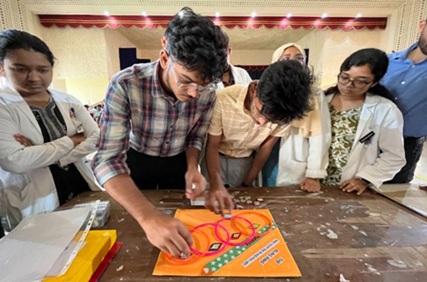
The practical sessions transform theory-room puzzles into interactive games designed to reduce monotony and increase student engagement. Students work in teams, discuss choices, learn from peers and self-regulate under facilitator guidance.
Additional examples include “Where in Venn”, a carom game, “Power of Pawns”, a jigsaw puzzle, “Build your Burj Khalifa” and “Sepsis balance”.
An online component reinforces learning through repeated practice. Students can revisit concepts at their own pace, supporting retention and continued learning beyond the classroom.